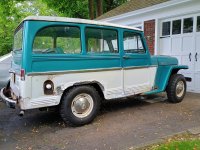
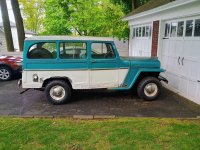
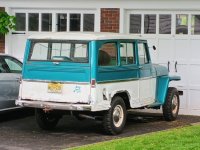
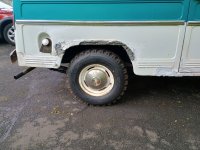
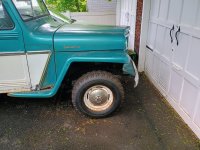
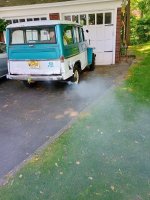
'63 Wagon - questions on 230 OHC Build/Rebuild among other things? Northern NJ

Yes, it's important to have a strong base under the rear floor area where the body is supported... hence our use of angle iron, across, to give real strength. This is not how a "purist" would do the repair, with a factory-design panel, but...

One other consideration - if you intend on having a trailer hitch, consider making a custom one that's really strong bolted to the frame. This might slightly protect the gas tank and also allow future external spare tire attachment (but that's another story).
Looks like rain, so the temporary stiffening job with the angled metal will have to wait.

It came with the hitch. There has been some discussion on this forum about these, but based on the photos folks have posted, the hitch is original. It bolts to the frame and the two pieces come together behind the bumper to another plate that shares a bumper attachment and then a flat piece of steel which juts out beyond the bumper upon which the ball is located. Here's a photo. You can see how the valence has some deformation on the right side - probably from taking some heavy loads with the tailgate down. Hole in the center of the valence is where one of the welded door hinges was located. The previous owner patched the gate where the other side of the hinge was attached.
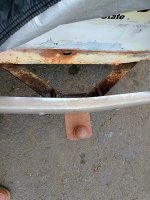
Hitch.jpg
 
The triangular shape of your hitch looks strong but I have to wonder why there isn't a central piece pointing aft... You could update your hitch to allow a standard 2" square removable insert. On the other hand, the current design will surely protect your bumper from people who park "by ear"! Your bumper looks to be in good shape (not repaired multiple times like mine) - it seems to have the faint Willys script too.
 
The triangular shape of your hitch looks strong but I have to wonder why there isn't a central piece pointing aft... You could update your hitch to allow a standard 2" square removable insert. On the other hand, the current design will surely protect your bumper from people who park "by ear"! Your bumper looks to be in good shape (not repaired multiple times like mine) - it seems to have the faint Willys script too.
There is a perpendicular plate right up against the rear of the bumper that you can't see. That's what the two pieces on either side of the angled pieces go up to. It is a solid piece and fairly common for the era as I understand it, however the bolts used where it meets the frame are completely rusted and locked into place. Need to be sawn/hammered out at some point
 
Okay, so this is the latest for the "hive mind".

Wagon spent a month or so during Snowmageddon just sitting in the driveway. I started it regularly but when the snow finally disappeared discovered that the brake pedal felt mushy. When up and down the driveway but I live on a hill so didn't want to go further. Emergency brake cable was broken when I got it. I have a new one but didn't install and don't have a hub puller, so I decided I'd have my mechanic look at the brakes and put in the new cable.

AAA came today and while backing the Wagon up to the street to drive onto the roll-back, the brakes locked up while in reverse. I pulled forward - they unlocked, then locked again. Did that a few more times with same results. So a lift truck had to be dispatched, pulled up the rear and ultimately brought the Wagon to the Mechanic's - front brakes not locked up.

Common problem when they've been sitting for a while? Would like folk's thoughts.
 
Are you even sure it's the brakes that locked up? It could also be any number of driveline related issues.

Also, (sorry, opinion time) I'm always concerned when I read "my mechanic" on these pages. Unless the guy is a hobbyist who's familiar with these old machines, or actually takes the time to research the proper manual, he probably knows less about how to fix your wagon than you do. For what you're going to pay him you could buy a nice quality made in USA hub puller on eBay and whatever other tools you need to fix it, plus you'll get a better understanding of your vehicle. These old things, compared to modern stuff, are very maintenance intensive, so it's always a good idea to do as much work on these yourself as possible.
 
Agreed, I took our wagon to a well respected shop in town to have a "safety check" 5 years ago and was told no one could deal with it except an old guy (the actual shop owner). He charged $200 to go over everything, I hope so at least, tightening the rear hubs, greasing the dozens of nipples etc. None of the young guys would go anywhere near the vehicle, perhaps because they could figure out why it had 3 pedals.
Experience has taught me that few people want to do any work that could be considered exotic these days. I've had guys turn down jobs from dry walling, plumbing, eves troughs installation to tall hedge trimming. If you have the time and energy/willingness, it's nearly always better to do the job yourself... excepting midwifery.
And, you get to build up an impressive set of tools over the years... perhaps giving you good points to get into heaven one day!
 
I use mechanics. My e brake mechanism has locked up. Not so bad as what you described, but yes, you getting under there and figuring out exactly what it is that is causing the locking up is worth doing, especially if you get the mechanicals done by a pro.
 
New Springs and Shocks! Kaiser-Willys purchase about a year ago - finally installed. Gained maybe three inches in height. Some of the banging and rattling have abated too!

Before (left) and After (right) pictures:
 

Attachments

  • Spring helpers.jpg
    Spring helpers.jpg
    294.2 KB · Views: 16
  • Suspension 1.jpg
    Suspension 1.jpg
    315.7 KB · Views: 16
Last edited:
Here's a question for all those Orscheln Brake Folks.

My wagon was built late '62 and titled a '63 so it has the Emergency Brake Handle (Orschlen) variation.

Folks who have followed my adventure know that the reason why I purchased this Wagon was because it was "painfully" original and I was hoping to benefit from some of the transitional upgrades from the Utility Wagon to the J-Series. I had a '53 Wagon several years ago and dealt with an under-powered engine, top-heaviness and the old "T-Handle" Emergency Brake which barely worked.

Orschlen is supposed to be a huge upgrade, but when I got the Wagon the loop cable to the rear braked was broken. The handle under the dash went up and down easily (I do know there is an adjuster on it), but I now have a brand new loop cable for the rear brakes and the handle just won't budge! I twisted the adjuster back and forth and got a couple of clicks but that's it. Locked up tight vertically but no EM brake engagement.

I'm thinking it went up and down easily with the broken brake cable because the sleeve and inner cable just moved together. Had my daughter yank on the handle with me under the wagon and could see the slight pull back and forth now with the rear cable attached. Thinking the cable in the outer jacket needs some lube or regular pulling on the handle to see if I can break it free. Otherwise I think I need to find a replacement cable/sleeve from the handle to the "U" shaped channel under-body-piece that the rear cable attaches to.

Counsel and advice?
 
If it's complete and doesn't have broken strands it can be lubed and probably freed up. It takes time for the lube to travel down the cable but most of the rust and resistance will be near the two ends and near any damage or kinks. The fact that it moves a little already is a good sign. Disconnect it at the lower end and see if it moves more/easier. This will isolate the front cable from the rest of the system and make it easier to determine for sure where the mechanism is hanging up. It could be a combination of places, all adding up to too much resistance to operate. Use penetrating oil to free it up and then follow with "shop oil" (the oil left in the cans after an oil change that you let drain over several days into a clean can). Treat it with the oil at the top by the firewall and let gravity and time (and occasionally working it) do the work for you. Also treat the other end and let it creep in from that end too.
 
If it's complete and doesn't have broken strands it can be lubed and probably freed up. It takes time for the lube to travel down the cable but most of the rust and resistance will be near the two ends and near any damage or kinks. The fact that it moves a little already is a good sign. Disconnect it at the lower end and see if it moves more/easier. This will isolate the front cable from the rest of the system and make it easier to determine for sure where the mechanism is hanging up. It could be a combination of places, all adding up to too much resistance to operate. Use penetrating oil to free it up and then follow with "shop oil" (the oil left in the cans after an oil change that you let drain over several days into a clean can). Treat it with the oil at the top by the firewall and let gravity and time (and occasionally working it) do the work for you. Also treat the other end and let it creep in from that end too.
Thanks Jeff. That will be my job this weekend...
 
Getting a little more play out of the cable. In the interim found the replacement at WillysJeepParts ($58.50), Willys America ($85) and Kaiser-Willys ($134). Length from the interior handle to the about 69". Looked at how it snakes through the firewall with a gradual bend under the battery box, attachment to the inner fender and then back down to the rear yoke. I'll continue trying to get what I have to work again.

Editing to say that I did go underneath the wagon for a bit - exterior rubber/plastic jacket and metal sleeve is all intact. Small crack at end that I sprayed the heck out of with a silicone penetrating oil. Did my best on the top-end near the handle. Put a wrench on the underside nut and octagon piece near the yolk where the rear brake wires loop through. Eventually started turning, but it was turning the nut where the cable from the dash meets the threaded rod piece. Getting a little play but wondering if the issue is with the adjusting rod to the yolk the rear cable loops through - like is it stuck on the cross piece or something.
 
Last edited:
So here's what I noticed yesterday and today. Looked into earlier messages on this thread and found some old comments about "smoking" from a year ago. Seemed this was an on and off issue with me.

I had added some marvel mystery oil to the tank last year and thought it might be that but yesterday I noticed much more smoke (other folks did too).

A year ago there was alot of speculation about oil pooling or someway getting past the valves. So today I timed it. Beautiful day here 80's - Engine fired right up - no need for choke. Really purring nicely. All fluids full. Oil clean (I've got a front plate leak that I still need to address, so do add a quart of dino oil from time to time).

Starts - NO SMOKE WHATSOEVER. Three to four minutes go by and then this! Run it for five (plus) more minutes, and it doesn’t abate. It just fills the yard with smoke. Then turn off... sigh
Smoke.jpg
 
Starts up with no choke could be an indicator of running rich, but at 80 degrees outside, maybe not.
I generally always needed the choke, but then cleaned up the points a bit (it had sat outside but under cover all Winter so the usual dampness issues) and got it to run alot better. Didn't really notice what I think is heavier smoking until a day or two ago. Would running rich create smoke? This smoke is lighter in color, but yesterday after a hard pull uphill into the driveway the engine did diesel for a moment when I shut it off.
 
Last edited:
Just tossing some stuff on the pile maybe something sticks. Or folks can plainy cross off this and go to their test.

  • If not engine related could it be some stuff in the exhaust burning off. Like the mystery oil has coated the inside of the exhaust. Can you use a piece of cardboard and let the smoke collect maybe the vapor will collect and straight water vapor will evaporate. But maybe with that much smoke the non water would settle and you can get a feel for what it is, antifreeze is sweet smelling, don't directly breathe the smoke! Wonder if like a balled up cheese cloth would do the same?

  • Remove the radiator cap and run it, that prevents the coolant system from building pressure, but at 3-5 minutes these are pretty cold engines even at that mark typically. See any physical bubbles in the coolant, just becareful coolant systems can de dangerous when running and pressures mix between combustion and coolant.

  • Pressure test your coolant system, you will need a larger adapter for the test set, the basic one I have was too small, they are free to rent at the Auto Parts Store if you return it at times, but you follow the directions engine cold and remove the radiator cap, pump it up, let it sit a bit, if you have anything might pick it up. There are cases where it maybe a Crack that only exposes it self when hot or warmed up. That could explain the shows up gets worse after 3-5 minutes. You dont pressure test when hot, from what I have done. The issue I found was the physical radiator cap is too large for the basic testers and you can bring your radiator cap to the store to see if their test set has the correct adapter. Been there.

  • Coolant and Exhaust gas, you can check that with a simple tester from the coolant side, typically you remove the radiator cap, (cold engine) as it warms up a little use the bottle with the dye if it changes color there is exhaust gas, might even see bubbles at times. Back in the day at work a bad head gasket would puke coolant all over after it warmed up so need to be careful at times if it gets too hot or a lot of pressure in the coolant, never did that on a Willys but other engines I have seen that.

  • Maybe can pull your plugs and keep them in order from 1 to 6, take pics of each plug and share, its like reading tea leaves at times, and I find it amazing most spark plug charts dont show burning coolant, but the cylinder will be super clean like steam cleaned.

  • Amazon has some pretty inexpensive bore scopes you can see inside the cylinder if the valves are super clean then thats a bad sign.

  • Unburned fuel was mentions so maybe that will show on the plugs as Carbon fouled.

  • Unburned oil would show as oil fouled, they can look the same at times, the shade and physical make up of the black is a little different.

  • Further down the rabbit hole, compression and leakage cylinder testing, again a Crack under heat smaller would be hard, the leakage test can be noisy at times with the air, if the engine comes off TDC which is what I experience having a hard time. Physically having a second person helps to make a mark hold it at TDC so the leakage test is valid, the idea is both valves are closed and you pressurize the cylinder chamber via the spark plug, any leakage from say and exhaust valve would go out the exhaust. Intake valve the carb, Crack in the cylinder wall the oil pan, Crack via a water jacket or head gasket could go back to the coolant system, or bad head gasket adjacent cylinder and coolant, one or the other.
 
Back
Top